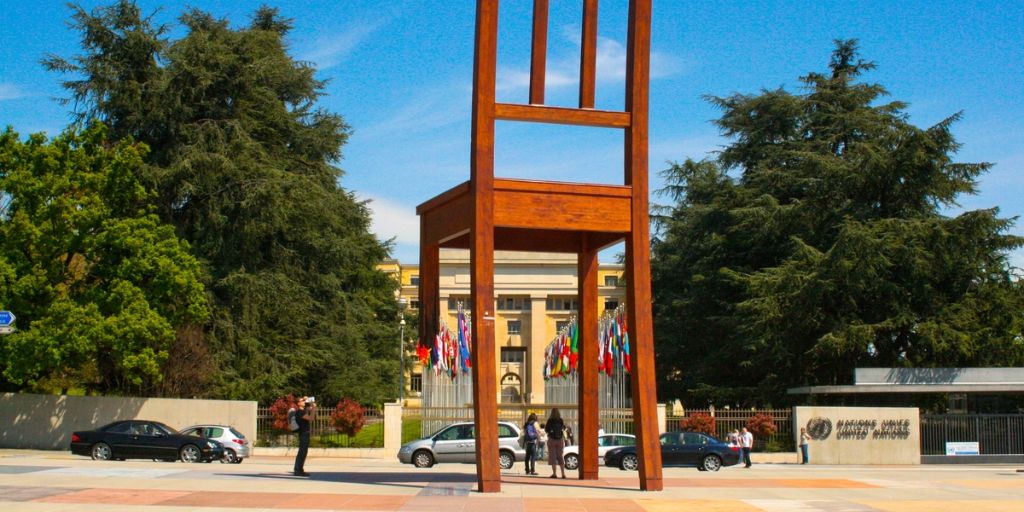
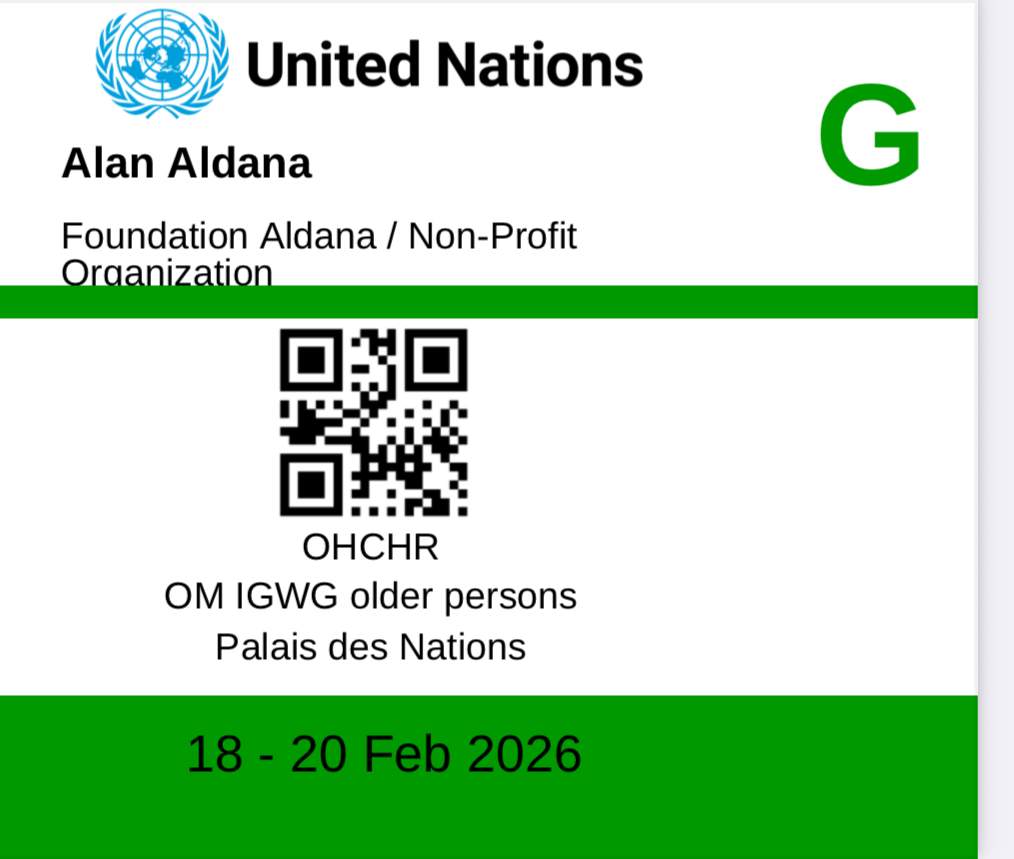
From February 18 to 20, 2026, the Aldana Foundation participated in the first organizational meeting of the United Nations Intergovernmental Working Group (IGWG), held at the Palais des Nations in Geneva. The meeting’s mandate is to draft a legally binding international treaty for the protection and promotion of the human rights of older persons.
This historic gathering, convened by the Office of the United Nations High Commissioner for Human Rights (OHCHR) under Human Rights Council Resolution 58/13, marked the formal start of a process that aims to transform how the international community recognizes, protects, and guarantees the rights of the elderly worldwide.
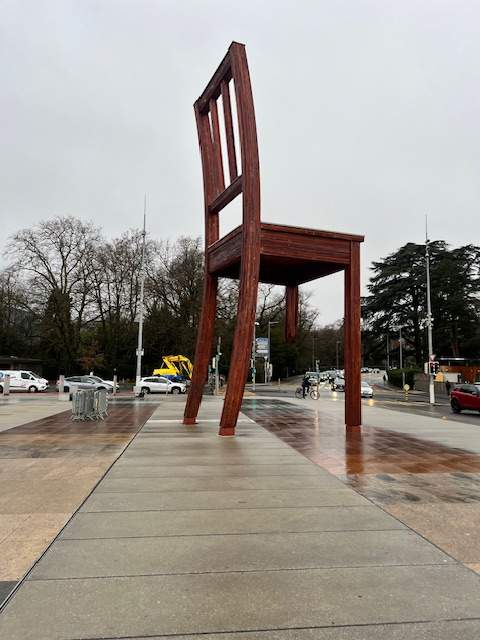
Venezuela’s Voice in the Face of a Global Challenge
The Aldana Foundation attended this meeting with a clear message: the protection of the rights of older persons cannot be viewed as an isolated issue. Instead, it is an essential pillar for rebuilding the social fabric of nations, particularly in contexts of humanitarian crisis and institutional decay, such as the one currently facing Venezuela.
From the Venezuelan perspective, the situation of older persons is especially grave. Decades of economic decline, the destruction of the social security system, hyperinflation, the collapse of healthcare services, and the mass migration of younger generations have left millions of seniors in conditions of extreme vulnerability: without adequate pensions, without access to essential medications, without family support networks, and, in many cases, in a state of abandonment.
However, the Aldana Foundation’s proposal transcends the diagnosis of a specific crisis. It is a comprehensive approach that, while born from the Venezuelan reality, is applicable to nearly all regions of the world where older persons face similar challenges.
“The dignity of older persons is not a concession from the State: it is a fundamental human right whose protection requires binding legal instruments, concrete public policies, and the active participation of civil society.”
— Aldana Foundation · Intervention before the IGWG, Geneva, February 2026.
Proposals Presented to the IGWG
The Aldana Foundation delegation presented a set of proposals centered on the idea that the recovery and restructuring of any country necessarily requires the reconstruction of its social fabric, and that older persons must hold a priority place in that reconstruction.
Key Areas of Action:
- Adequate Pensions and Effective Social Security To ensure that any international instrument obligates States to establish pension systems that cover the real basic needs of older persons, indexed to the cost of living, with international oversight mechanisms to verify compliance.
- Subsidies for Grandchild Care In contexts where forced migration has left grandparents as the primary caregivers for their grandchildren, it is essential for States to recognize this reality through specific financial aid for older adults who assume substitute parental roles.
- Specialized Professional Support in Caregiving To promote programs for companionship and assistance for older persons through personnel trained in gerontology, social work, and home care, ensuring that care does not fall exclusively on families nor becomes dehumanized through institutionalization.
- Preventive Medicine and Palliative Care To incorporate into the future international treaty the obligation of States to guarantee universal access for older persons to preventive health programs and dignified palliative care, ensuring an adequate quality of life in the final stages of existence.
Rebuilding the Social Fabric
Drawing from the Venezuelan experience, the Foundation emphasized that the restructuring and recovery of a country cannot be achieved without addressing the needs of its older citizens. The social fabric is rebuilt from the ground up: by ensuring that those who have contributed to society throughout their lives receive the dignified treatment they deserve.
A Universal Scope
While the Aldana Foundation’s proposals stem from direct observation of the Venezuelan crisis, the issues they address are shared by societies worldwide. Population aging, insufficient pension systems, unwanted loneliness, lack of access to specialized healthcare, and the invisibility of older persons in public policy are phenomena affecting both developing and industrialized nations.
Consequently, the Foundation’s intervention was received with great interest by the delegations present, as it offers a concrete and operational framework that can be adapted to diverse realities.
The Context: Toward a Binding International Treaty
The IGWG organizational meeting in Geneva constitutes the first formal step in a process that will continue throughout 2026, with substantive sessions scheduled for July and October. The ultimate goal is the drafting of an international convention—a treaty with mandatory legal force—that establishes minimum standards for the protection of the rights of older persons and accountability mechanisms for States.
To date, older persons remain one of the population groups with the least specific protection under international human rights law. Unlike children (Convention on the Rights of the Child), women (CEDAW), or persons with disabilities (CRPD), there is not yet an instrument dedicated exclusively to the elderly. The IGWG has the mandate to close this historical gap.
The Aldana Foundation will actively participate in the upcoming sessions of the working group and will continue to provide the perspective of Latin American civil society, with a special emphasis on the needs of older persons in humanitarian crisis contexts and the importance of incorporating verification and monitoring mechanisms into the future treaty.
Commitment of the Aldana Foundation
The presence of the Aldana Foundation at the Palais des Nations in Geneva reaffirms its commitment to the defense of human rights through civil society. The Foundation will continue working to ensure that the voices of older persons—especially those living in the most vulnerable conditions—are heard in the international forums where the rules that will protect them are decided.
Because a society that does not care for its elders is a society that has lost the memory of what it is and the vision of what it can become.
Aldana Foundation
Non-profit organization dedicated to the defense of human rights.
www.fundacionaldana.org